

Every week, a new “GEO expert” pops up on LinkedIn with a hot take about how to get recommended by ChatGPT. Most of them are recycling the same three talking points. Some are flat-out wrong. And almost none of them cite actual research.
We got tired of it. So we built our own knowledge base.
We analyzed over 40,000 websites and web pages, read every academic paper, industry study, and platform announcement we could find about Generative Engine Optimization, and compiled the results into 72 structured documents sourced from 1,500+ unique references across 11 research categories. It turned out so well that we decided to start publishing what we found.
This is the first article. Here’s what actually drives AI visibility, and what doesn’t.
The Short Version
Our research covers studies spanning 129,000+ domain evaluations (Digital Bloom), 10,000 controlled queries (Princeton/Georgia Tech), 36 million AI Overviews (Surfer SEO), and dozens of independent experiments. We cross-referenced findings from academic databases, industry publications, and primary source data.
The industry knows more than most practitioners realize, but the signal is buried under noise, contradictions, and marketing spin. This article distills the corpus into the 9 findings that actually matter.
What We Covered: The Research Scope
We organized our research across 11 categories:
| # | Category | Focus |
|---|---|---|
| 1 | Fundamentals | What GEO is, how it differs from SEO |
| 2 | Research & Data | Academic papers, industry reports, experiments |
| 3 | Tools & Platforms | GEO tools, monitoring platforms, AI features |
| 4 | Thought Leadership | Key voices, credible analysis, noise detection |
| 5 | Signals & Trends | Social signals, job market, funding, community |
| 6 | Use Cases & Verticals | Industry-specific GEO (healthcare, legal, SaaS, etc.) |
| 7 | Tactics & Implementation | How-to techniques, measurement, technical steps |
| 8 | Model-Specific Optimization | Per-model behavior (ChatGPT, Gemini, Perplexity, Claude, Grok) |
| 9 | Business Case & ROI | ROI frameworks, pricing, market sizing |
| 10 | Controversies | Myths, skeptics, ethics, hallucination risks |
| 11 | Adjacent Ecosystem | AI agents, voice search, knowledge graphs, social search |
Across these categories, we reviewed over 40,000 websites and web pages, synthesized 1,500+ unique sources, and produced 72 structured knowledgebase documents.
Finding #1: The GEO Market Is Real. $1.09B and Growing at 40.6% CAGR
This isn’t speculative. Dimension Market Research sizes the GEO market at $1.09 billion in 2026, growing to $17.15 billion by 2034 at a 40.6% compound annual growth rate. McKinsey projects $750 billion in US revenue will funnel through AI-powered search by 2028.
The adoption numbers support this:
- 800M+ weekly active users on ChatGPT alone
- 1.5B+ monthly users on Google AI Overviews (5 billion uses/month as of Google I/O May 2025)
- AI search traffic grew 527% YoY (Ahrefs) and AI referrals hit 1.13 billion visits, up 357% YoY (Conductor, June 2025)
- 29% of B2B buyers now start their research with AI over Google (G2, 2025)
The question isn’t whether GEO matters. It’s whether you’re already behind.
Finding #2: AI Visitors Convert at 4.4x the Rate of Organic
This was the single most commercially significant finding in our corpus.
Semrush’s 2025 data shows AI-referred visitors convert at 4.4 times the rate of traditional organic visitors. Go Fish Digital’s research puts it even higher: 25x higher conversion for AI referral traffic versus traditional search.
Why? When ChatGPT or Perplexity recommends your brand, the user arrives pre-qualified. They’re not browsing 10 blue links. They received a direct recommendation from a system they trust.
| Metric | Value | Source |
|---|---|---|
| AI visitor conversion vs. organic | 4.4x higher | Semrush, 2025 |
| AI referral conversion vs. traditional | 25x higher | Go Fish Digital, 2025 |
| LLM traffic conversion rate | 3.76% vs. 1.19% organic | Amsive, 2025 |
| Average GEO CAC | $559 (declining -37.5%) | First Page Sage, 127 companies |
Caveat: Amsive’s own data showed no significant difference (4.87% vs. 4.60%). Honest research means reporting contradictions. The variance likely depends on industry, query type, and attribution methodology. But the directional signal across multiple studies is clear: AI traffic converts better.
Finding #3: ~40% of GEO Overlaps with SEO, But 60% Is Genuinely Different
The most contentious finding. “GEO is just rebranded SEO” is partially true, but it misses the majority of what’s actually different.
The 40% that overlaps (Foundation Layer):
- Technical accessibility (crawlable, fast, structured)
- E-E-A-T signals (expertise, experience, authoritativeness, trustworthiness)
- High-quality, accurate content
- Schema markup and structured data
The 60% that’s genuinely different (GEO-Specific Layer):
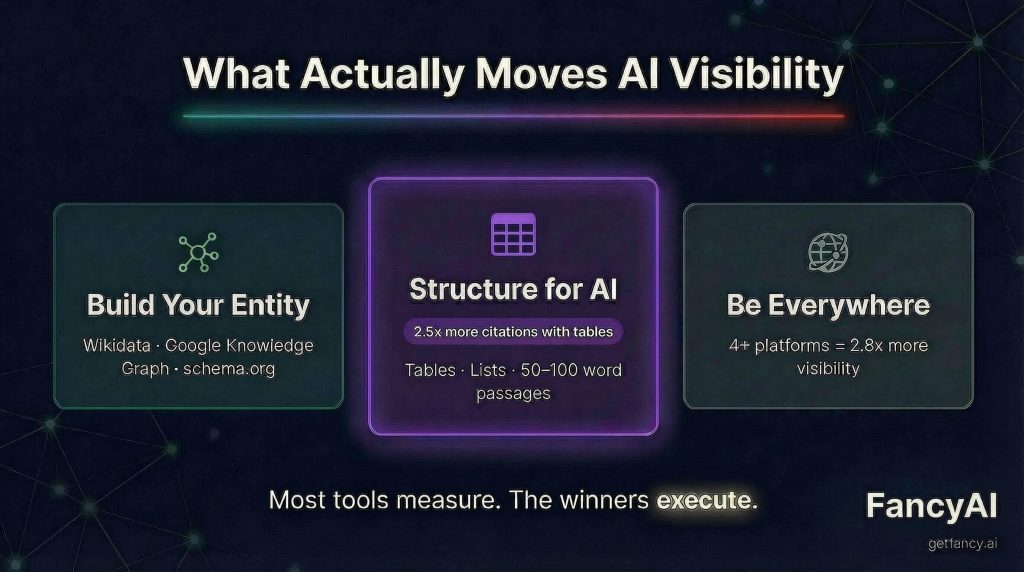
- Entity optimization. Build your brand as a well-defined entity in Wikidata, Google Knowledge Graph, and schema.org. This is the foundational layer everything else depends on.
- Passage-level optimization. Structure content in 50-150 word self-contained sections for AI extraction. The unit of optimization shifts from pages to passages.
- Citation-worthy content. Original data, statistics, expert quotes. Statistics improve AI visibility by 41% (Princeton/Georgia Tech, 10,000 queries).
- Cross-platform consistency. Brands on 4+ platforms are 2.8x more likely to appear in ChatGPT (Digital Bloom, 129,000+ domains).
- Earned media / digital PR. 61% of AI brand signals come from editorial media (University of Toronto).
- Social proof signals. Reddit is the #1 most-cited source across AI platforms; LinkedIn is #2.
- Multi-format content. YouTube is cited in 29.5% of AI Overviews. Transcripts and VideoObject schema are critical.
Google’s own John Mueller confirmed the foundation: “AI systems rely on search. There is no such thing as GEO or AEO without doing SEO fundamentals.” (January 2026)
Finding #4: The Signal Hierarchy Inverts Traditional SEO Priorities
This was the most counterintuitive finding. The signals that drive AI visibility are fundamentally different from what drives traditional search rankings.
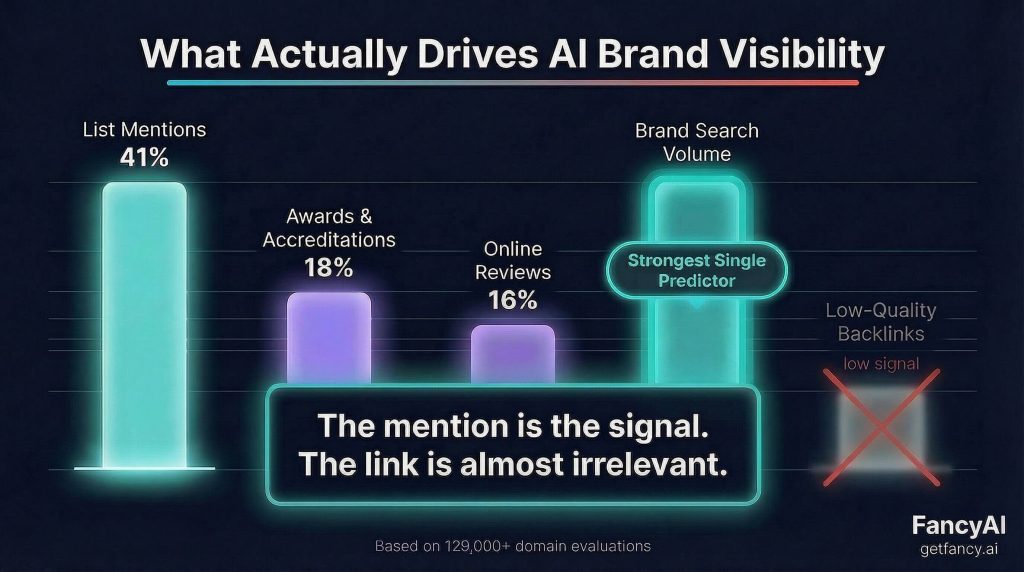
| Signal | Weight in AI Recommendations | Notes |
|---|---|---|
| Authoritative list mentions | 41% | Being named in “best of” lists, roundups, directories |
| Awards & accreditations | 18% | Third-party validation |
| Online reviews | 16% | Especially for branded queries |
| Brand search volume | Strongest single predictor | 0.334 correlation coefficient |
| Low-quality backlinks | Weak/neutral | The link itself doesn’t drive AI visibility (129,000+ domain evaluations) |
That last row is the key distinction. Digital Bloom’s 2025 study of 129,000+ domains found that low-quality backlinks show “weak or neutral correlation” with LLM visibility. The link itself, the thing the entire SEO industry has spent two decades building, doesn’t move the needle for AI.
But look at the top of the table: being mentioned by name matters enormously. The 41% weight on list mentions isn’t about the hyperlink. It’s about the mention. When a “Best CRM for Small Business” article names your brand, AI learns that association whether or not there’s a link attached. The mention is the signal. The link is almost irrelevant.
What matters: being named in authoritative lists, earning third-party validation, and building brand recognition that drives search volume. Not buying links.
Finding #5: Each AI Platform Behaves Differently. Only 11% Overlap
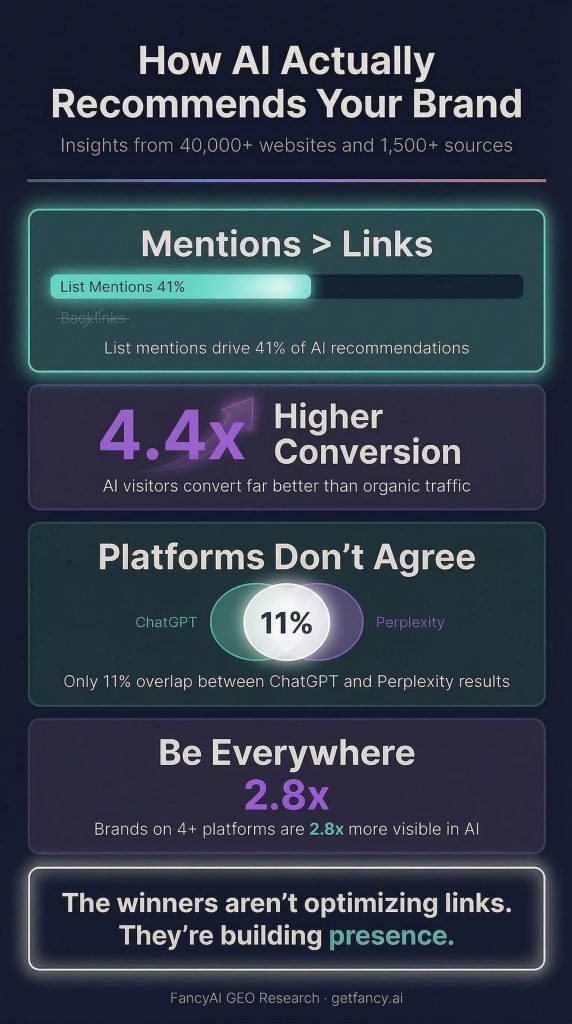
One of the most practical findings for execution: each AI platform has distinct citation behaviors, and only 11% of domains cited by ChatGPT are also cited by Perplexity (Digital Bloom, 2025).
| Platform | Search Backend | Sources per Response | Top Source |
|---|---|---|---|
| ChatGPT | Bing | 3-4 | Wikipedia (47.9%) |
| Perplexity | Proprietary (200B+ URLs) + Bing | ~13 | Reddit (46.7%) |
| Google AI Overviews | 3-5 | YouTube (#1, 34% growth) | |
| Claude | Brave Search | Varies | 86.7% overlap with Brave results |
| Grok | Proprietary + X/Twitter | Varies | X/Twitter data |
This means optimizing for one platform doesn’t guarantee visibility on others. A multi-platform strategy is essential, and it explains why brands on 4+ platforms are 2.8x more likely to appear in ChatGPT.
Finding #6: Content Structure Matters More Than Content Length
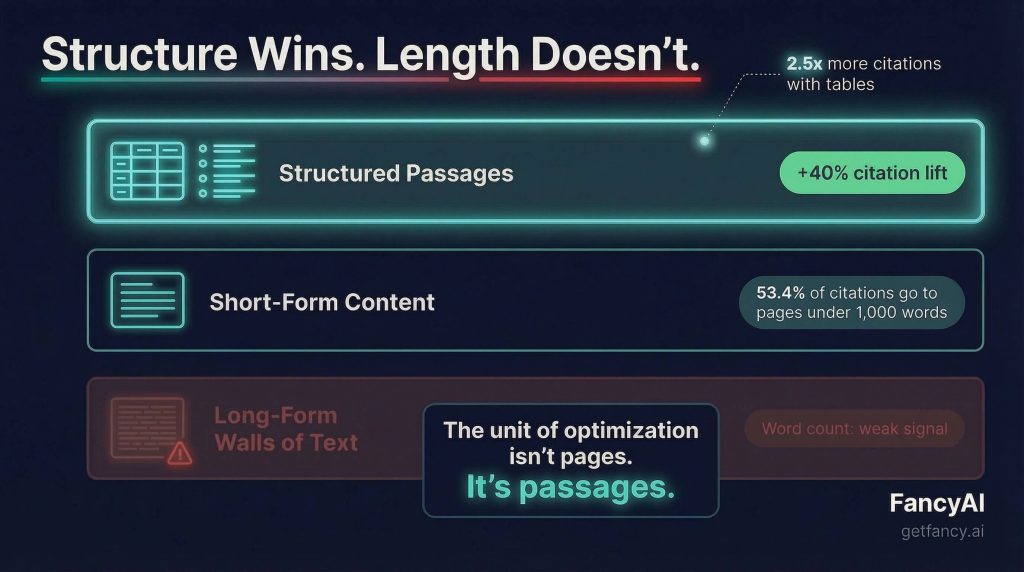
Word count has a near-zero correlation (0.04) with AI citation likelihood (Ahrefs, 2025). In fact, 53.4% of pages cited by AI are under 1,000 words.
What does matter:
| Optimization | Impact | Source |
|---|---|---|
| Adding statistics | +41% AI visibility | Princeton/Georgia Tech, 10,000 queries |
| Citing sources | +30-40% visibility | Princeton/Georgia Tech |
| Expert quotes | +22% (Perplexity specifically) | Princeton/Georgia Tech |
| Structured content (H2/H3/bullets) | +40% citation lift | Convert.com, 2025 |
| Comparison tables | 2.5x more citations than prose | Digital Bloom, 2025 |
| Content freshness (within 30 days) | 3.2x more citations | SISTRIX, 2025 |
| Lower-ranked sites using these tactics | +115% for rank-5 sites | Princeton/Georgia Tech |
That last point is crucial: GEO tactics disproportionately benefit sites that aren’t already ranking #1. Lower-ranked sites saw a 115% visibility improvement by applying statistics, citations, and structured formatting, even without improving their traditional search ranking.
Finding #7: Citation Accuracy Is 50-66%. AI Hallucination Is Real
We can’t discuss GEO without acknowledging the elephant in the room. Wu et al.’s 2025 study in Nature Communications found that only 50-66% of AI citations actually support the claims they’re attached to.
And SparkToro’s Rand Fishkin demonstrated that there’s less than a 1 in 100 chance ChatGPT will give the same brand recommendation list twice for identical prompts. “Ranking position in AI” is a meaningless concept. The valid metric is visibility percentage across many runs.
This has two implications:
- For measurement: You can’t check your “AI ranking” once and draw conclusions. You need continuous monitoring across many queries and many runs. This is why we built FancyGEO’s Action Plans to audit across all 5 major LLMs. A single check tells you almost nothing.
- For strategy: AI will sometimes cite you incorrectly. Brand monitoring and sentiment tracking aren’t optional.
Finding #8: The Cost of Inaction Is Measurable
The data on traffic decline is sobering:
- 80% of consumers rely on zero-click results at least 40% of the time (Bain, 2025)
- HubSpot lost 70-80% of its organic traffic
- Forbes declined 50%; CNN dropped 27-38%
- $2 billion in annual ad revenue loss estimated for publishers from AI search
- Organic CTR has dropped 34.5% to 61% on queries with AI Overviews (Ahrefs, Seer Interactive)
Gartner predicts a 25% decline in traditional search by 2026. Ahrefs projects 50% by 2028.
The traffic isn’t disappearing. It’s being redirected through AI intermediaries. The question is whether your brand is the one being recommended.
Finding #9: The Payback Timeline Is Faster Than You Think
Across our research, the GEO ROI timeline consistently shows:
- First citations: 4-8 weeks after implementing GEO tactics
- Pipeline impact: Months 4-6
- Positive ROI: Months 7-12
- Published ROI range: 267% to 1,937% depending on methodology
The average GEO customer acquisition cost is $559 across industries (First Page Sage, 127 companies), and it’s declining at 37.5% as the market matures. For comparison, Google Ads CPC has been increasing 10-15% annually.
Forrester’s recommendation: reallocate at least 15% of your content and digital spend to AI search optimization.
The 10 Things You Should Do Now
Based on everything we found across 1,991 queries, here’s what actually moves the needle:
- Start with entity optimization. Build your brand in Wikidata, Google Knowledge Graph, and schema.org. Everything else depends on this.
- Structure content for AI extraction. Use listicle formats (50% of top AI citations), tables (2.5x more citations), and 50-150 word passage blocks.
- Invest in original research and data. Statistics improve AI visibility by 41%. Original data is the single strongest differentiator. It’s what AI cannot generate.
- Prioritize earned media. 61% of AI brand signals come from editorial media. Target publications AI already cites for your category.
- Build Reddit and LinkedIn presence. Reddit is #1 most-cited; LinkedIn is #2. Authenticity and helpfulness beat promotion.
- Optimize for multiple AI platforms. Each behaves differently. Cross-platform consistency (4+ platforms) increases ChatGPT appearance by 2.8x.
- Create video content with proper metadata. YouTube is cited in 29.5% of AI Overviews. Transcripts, captions, and VideoObject schema are critical.
- Measure citation share, not just rankings. Track Brand Visibility Score, citation rate, share of voice, and sentiment across AI platforms.
- Don’t abandon SEO. Google searches grew 22% YoY in 2024. GEO builds ON SEO, not instead of it.
- Move fast. AI models are learning which sources to trust during this formative period. Early movers establish default citation positions that become exponentially harder to displace.
What We’re Doing With This Research
We didn’t build this corpus just to publish one article. At FancyAI, we used these findings to architect FancyGEO, a platform that doesn’t just measure AI visibility, but executes the work required to improve it. Most GEO tools stop at monitoring. FancyGEO identifies the prompts your customers ask AI, analyzes how AI currently answers, generates an optimization strategy, and automatically executes changes: content updates, technical fixes, structured data, authority signals, and paid media placements.
Every recommendation in FancyGEO’s 18-task-type engine is grounded in findings from this research. When the system generates a CONTENT-FRESHNESS recommendation, it’s because our data shows content published within 30 days gets 3.2x more citations. When it prioritizes entity optimization, it’s because cross-platform presence (4+ platforms) correlates with 2.8x higher ChatGPT visibility.
We’ll be publishing findings from this corpus weekly, each article diving deep into one category. Next week: a map of who’s credible in the GEO space and who’s noise.
Want to go from invisible in AI to consistently recommended? See how FancyGEO works →
Sources
- Aggarwal, P. et al. “GEO: Generative Engine Optimization.” Princeton/Georgia Tech, arXiv 2023 / ACM SIGKDD 2024. 10,000 queries.
- Digital Bloom. “2025 AI Citation & LLM Visibility Report.” 129,000+ domain evaluations, 2025.
- First Page Sage (Evan Bailyn). “GEO Strategy Guide.” 11,000+ queries, 127 companies, 2025.
- McKinsey & Company. “New Front Door to the Internet.” August 2025.
- Bain & Company. “Goodbye Clicks, Hello AI: Zero-Click Search Redefines Marketing.” 2025.
- Semrush. “Investigating ChatGPT Search.” 80M clickstream data points, 2025.
- SparkToro (Rand Fishkin). “AIs Are Highly Inconsistent When Recommending Brands.” 2025.
- Wu et al. “Citation Accuracy in AI Systems.” Nature Communications, April 2025.
- Dimension Market Research. “Generative Engine Optimization Market Size.” 2025.
- Ahrefs. “AI Overviews Reduce Clicks by 34.5%.” 2025.
- Conductor. “AI Sends 1% of Traffic, Mostly from ChatGPT.” June 2025.
- G2. “2025 Buyer Behavior Report.” 2025.
- Onely (Bartosz Goralewicz). “How ChatGPT Decides Which Brands to Recommend.” 2025.
- SE Ranking (Yulia Deda). “How to Optimize for ChatGPT.” 129,000 domains, 20 niches, 2025.
- SISTRIX. “Top 100 Most-Cited Websites.” 2025.
- Convert.com. “AI Search Optimization Strategies.” 2025.
- Gartner. Traditional search decline forecast, 2025.
- Seer Interactive. “AIO Impact on Google CTR.” 2025.
- Go Fish Digital. “GEO Case Study: 3X’ing Leads.” 2025.
- Amsive. “Answer Engine Optimization (AEO): Your Complete Guide.” 2025.
- Google (John Mueller). “Top Ways to Ensure Content Performs Well.” Google Search Central, May 2025. Statement on GEO and SEO fundamentals, January 2026.